Cooking robots are gaining attention because they target a task people repeat every day: making food. The useful question is narrower than “can a robot cook?” It is which parts of cooking a robot can handle safely, cleanly, and at a reasonable cost.
- Repeated tasks suit automation better than open-ended cooking.
- Cameras, sensors, and recipe software still need clear limits.
- Cleaning and food safety may matter more than arm movement.
Repetition gives robots a clear job
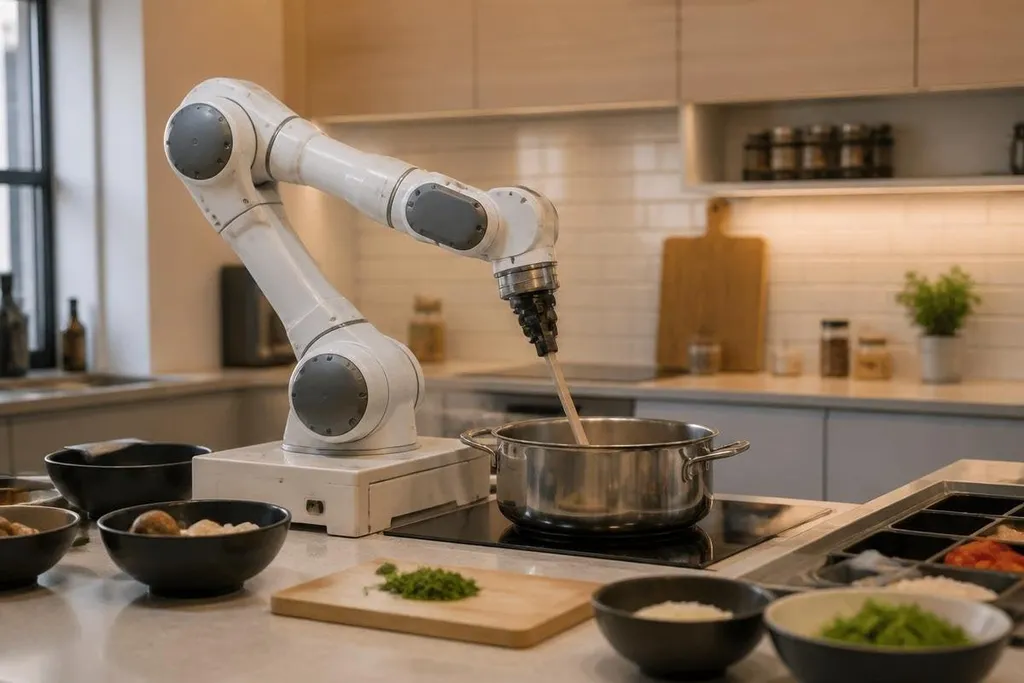
Robots work best when the task stays within known limits. A kitchen offers many such tasks: stirring a pot, moving ingredients, dispensing measured amounts, or watching a cooking time.
That makes cooking different from tasks that need a robot to understand an entire room. A recipe gives the system an ordered plan. The robot can read a temperature, check a timer, and move an ingredient to a known place.
The limits show up when the plan changes. A tomato may be larger than expected. Dough may stick to a bowl. A pan may sit a few centimeters off its marked position. Human cooks adjust without stopping to rebuild the plan; a robot needs sensors and software that can handle those changes.
This is why narrow cooking systems have a better path than a machine promised to make any meal. A robot that handles one repeatable step can work in a kitchen long before a robot that cooks an entire dinner alone.
The hardware is only half the job
A cooking robot may use an arm, a gripper, cameras, weight sensors, and a heat source. Each part has a plain job. The arm moves. The gripper holds. The camera checks position. The sensor measures contact or weight.
The software connects those actions to a recipe. It must know when an ingredient has reached the pan, when a tool has slipped, and when heat has changed the food. That last part is hard because food changes shape, color, texture, and weight as it cooks.
A camera can see that a surface has become darker. It may not know if the food is ready inside. A timer can mark ten minutes. It cannot account for a cold pan, a different ingredient size, or a lid that stayed open.
Those limits matter beyond the recipe itself. Robot24.com cooking robotics coverage can connect cooking-robot claims to named companies, models, test settings, and dates before the next section looks at kitchen safety.
The kitchen sets a high safety standard
A factory robot works in a space built around its movements. A home kitchen does not. People reach across the same counter, children may enter the room, and hot liquid can spill outside the planned work area.
Food also adds rules that a robot arm alone cannot solve. Tools need cleaning. Ingredients may contain allergens. Raw meat needs separate handling from ready-to-eat food. A useful cooking system must make those risks easier to control, not harder to see.
Cleaning may decide the product’s value. If a robot saves ten minutes during cooking but adds twenty minutes of washing, its daily benefit shrinks.
The same applies to setup. A person should not need to place every ingredient within a narrow marked zone before the robot can start.
Price matters too, but no price is supplied here for a specific cooking robot. That makes a firm buying verdict impossible. A household would need the machine’s purchase cost, service terms, cleaning time, and the number of meals it can handle before the system earns its space.
Use this test before buying one
A buyer comparing a cooking robot should check the complete task, not the arm alone:
- Named meals: Count the recipes the system can perform without manual steps.
- Human access: Check how the robot stops when someone reaches into its work area.
- Food contact: Ask which parts touch food and how each part gets cleaned.
- Heat control: Find out how the system checks pan temperature and cooking time.
- Failure recovery: See what happens after a dropped ingredient, blocked gripper, or power loss.
- Total cost: Add the machine, cookware, service, replacement parts, and setup time.
Cooking robots are getting attention because the basic idea fits a repeated household task. Their value will depend on smaller details: safe heat control, clean food contact, useful recovery after mistakes, and a job narrow enough for the software to manage.
I'd skip any system that sells a moving arm before it explains cleaning, safety, and what happens when a recipe goes wrong. The next useful proof is a full meal run with no hidden human steps, followed by the same kitchen being cleaned.